Commercial Window Cleaning Brisbane: What to Expect in 2026
Commercial Window Cleaning Brisbane: What to Expect
First impressions matter. When a prospective client walks up to an office, or a customer approaches a retail storefront on a sunny Brisbane morning, the glass is part of the building's presentation.
Fingerprints on entrance doors, dust on showroom windows and marks on awnings are practical reasons to plan a repeatable cleaning scope. In the competitive Brisbane Northside market—from the showrooms in Ascot to the medical centres in Chermside—the right method depends on the building, access and operating needs.
This guide explains the questions to ask before approving commercial window cleaning. It is intended as planning information, not a substitute for a property-specific safety or legal assessment.
For the transactional service page, see commercial window and exterior cleaning in Brisbane.
Planning a commercial clean?
Share the property details and requested scope for a site-specific review. Request a commercial proposal.
Beyond the Squeegee: The Scope of Commercial Cleans
If you run a small office in Mango Hill or a retail strip in Redcliffe, commercial window cleaning is more than choosing a product. The proposal should identify the surfaces, access points, operating constraints and expected finish.
1. Plan Around Occupied Spaces
A practical plan can reduce avoidable interruptions without promising that work will be invisible or disruption-free.
- Scheduling: Consider trading hours, resident access, deliveries, customer flow and weather when selecting a work window.
- Noise and equipment: Confirm which equipment is proposed and whether it suits medical, office, retail or education settings.
- Public areas: Agree how people, doors, cords, water and equipment will be managed around entrances and walkways.
2. Review Safety and Documents
Before allowing a contractor on-site, ask which documents and controls apply to the proposed work:
- Work method: Request a site-specific method or risk document where the work and legislation require it.
- Insurance documentation: Ask to review current documentation and confirm that it covers the proposed activity and property.
- Training: RIIWHS204E is a verified unit covering work safely at heights, fall hazards, control measures and fall-protection equipment. It should not be presented as a blanket high-rise licence.
- Access controls: Confirm exclusion zones, access to locked areas, protection of occupants and a response plan for changing conditions.
The appropriate documents, controls and access method depend on the property and the agreed work scope. Treat any certificate or plan as something to review for the job, rather than as a universal promise.
Pure Water as One Possible Method
De-ionised or pure-water systems can be considered for some exterior glass because they reduce mineral residue during the cleaning process. They are not automatically suitable for every surface, height or access condition.
When comparing methods, ask:
- Which windows and surfaces are included?
- How will the equipment reach each area?
- What happens near pedestrians, vehicles, balconies or sensitive finishes?
- How will the result be checked and recorded?
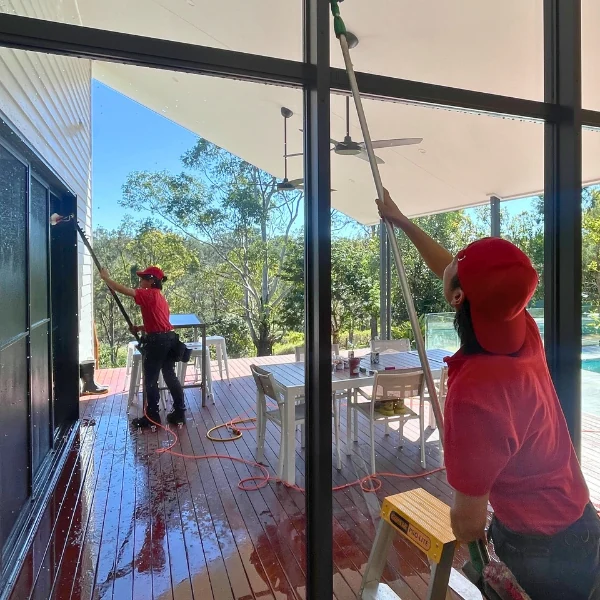
For higher or harder-to-reach areas, a site review should establish whether a reach pole, internal method or another controlled access method is suitable. RIIWHS204E training information is useful context, but training evidence does not replace a property-specific assessment.
Industry-Specific Planning Questions
Different properties have different practical constraints:
Medical and Professional Suites
Confirm privacy, noise, appointment schedules, access permissions and any films or finishes that need special handling.
Retail and Showrooms
Agree treatment of entrance doors, touch points, display glass, frames and customer circulation areas. A lower-traffic work window may be useful, subject to the property's approval.
Schools and Early Learning
Confirm drop-off and pick-up periods, communication responsibilities, exclusion areas, product requirements and the handover standard before work begins.
Internal Glass and Partition Challenges
Boardroom partitions, glass balustrades and entrance foyers often collect fingerprints and dust from normal use. The proposal should distinguish internal glass, frames, doors, tracks and any exclusions so that everyone has the same expectation.
Ask whether the proposed products suit the glass, films and surrounding finishes. A clear scope is more useful than a generic promise of a perfect result across every surface.
Set a Maintenance Schedule After the Baseline
The right frequency depends on exposure, traffic, nearby construction, salt air, weather and the appearance standard required by the business. A baseline clean can help identify recurring marks and decide whether a monthly, quarterly or less frequent visit is appropriate.
Record the agreed areas, access arrangements, exclusions, preferred work windows and review date. Once a proposal is approved, agreed job details and follow-up dates can be managed in ServiceM8.
What to Ask for in a Commercial Proposal
Before approval, ask for:
- A list of included surfaces and areas.
- The proposed method and access assumptions.
- Applicable safety and insurance documentation.
- Occupant, pedestrian and property-protection controls.
- The requested schedule, exclusions and change process.
Confirm access, insurance documentation, safety controls, scope, and scheduling for the specific property before work is approved.
Conclusion: Make the Scope Clear
Commercial window cleaning is easier to compare when the property, method and approval conditions are written down. Use this guide to prepare questions, then request a proposal that reflects the actual site rather than relying on a generic capability statement.
Discuss Your Commercial Property
Share the surfaces, access details and preferred timing so the requested scope can be reviewed for your Brisbane property.
What our customers say on Google
5.0 out of 5105 Google reviews“Great service and very professional. The windows look spotless and the attention to detail was excellent. Highly recommend”
Google rating checked 22 October 2026.
About the Author
Michael
Founder & Lead Technician
Michael is the driving force behind Sparkle Window Cleaning. With years of experience serving the Brisbane Northside community, he is dedicated to providing high-quality exterior cleaning services with a focus on reliability and customer satisfaction.
Related Services
Explore our other professional exterior cleaning services